

COMMUNIQUE | CWWM-CANADA
Email:[email protected]
Churches Witnessing With Migrants-Canada: Interfaith Forum for Migrant Justice Toronto, June 26, 2026 – Approximately 50 migrant workers, faith leaders, migrant service providers, and community advocates gathered on June 25–26 for the Interfaith Forum for
Migrant Justice organized by the Churches Witnessing With Migrants (CWWM)-Canada at the Charbonnel Lounge, University of St. Michael’s College at the University of Toronto.
The Interfaith Forum brought together these individuals and groups to help build and strengthen interfaith solidarity for migrant justice, discuss the impacts of Canada’s anti-imm/migrant immigration policies, and advance campaigns for regularization and the abolition of closed work permits.
Johnny Moore, a Cree author and Fire Keeper, opened the forum with greetings, prayer and an intentional ritual with sacred tobacco, and reflected on the interconnectedness of the struggles of migrants and that of the First Nations.
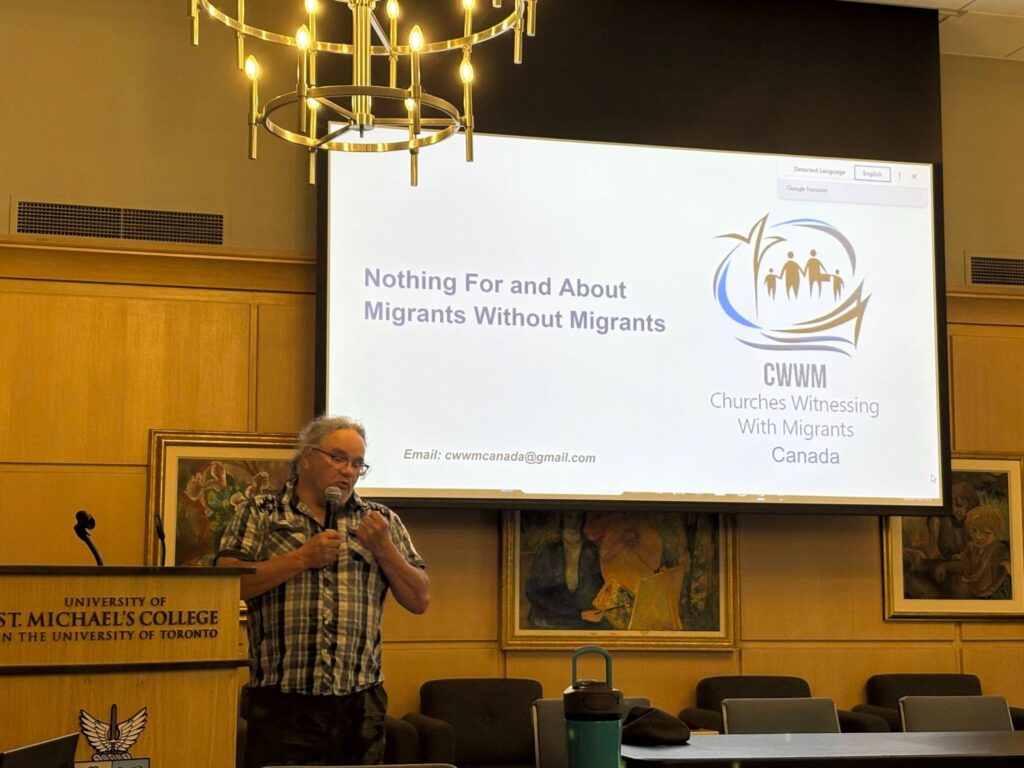
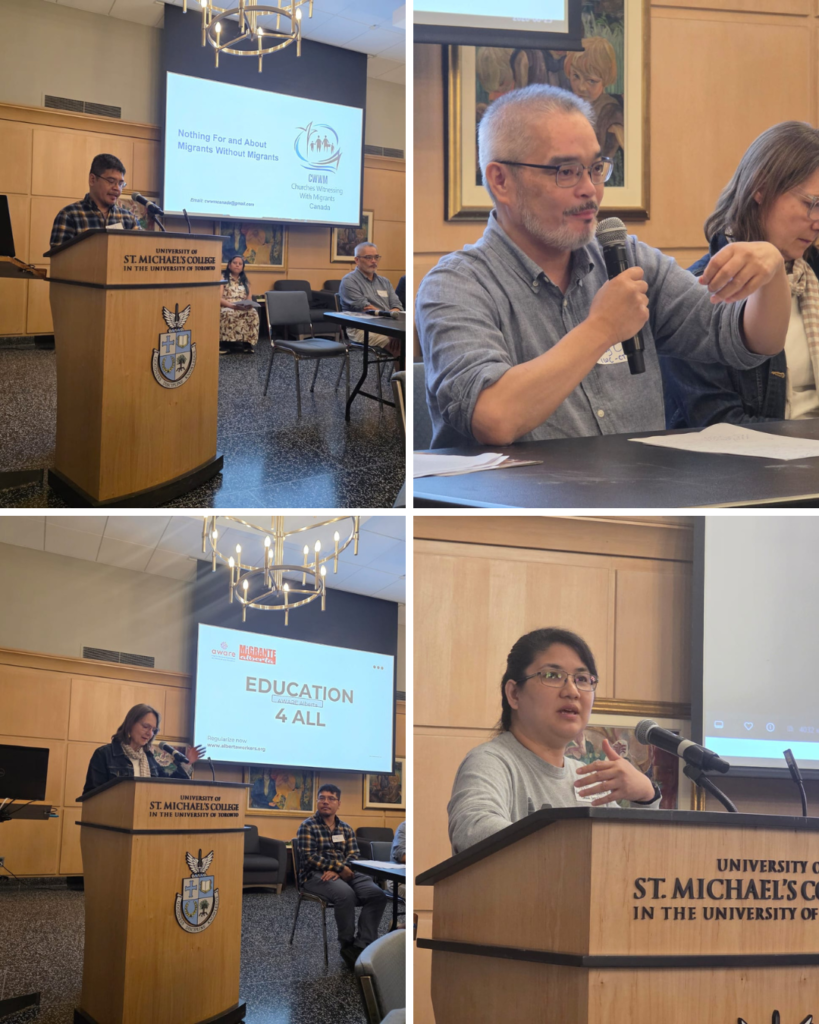
The first day started with a panel of speakers on why religious communities and churches are mobilizing in solidarity with migrants.
Rev. Ariel Siagan of the Asbury & West United Church in Toronto spoke about the moral and spiritual responsibility of churches to resist systems that reduce people to labour, price, or function and perpetuate conditions of modern-day slavery. “When a person is turned into a price unit, they become a commodity,” said Rev. Siagan. “This dehumanizes people and strips them of their desires, dignity, and full humanity. Churches must be a counterforce to systems that normalize this.”
Joey Calugay of the Montreal-based Immigrant Workers Centre (IWC-CT) talked about the immediate and harmful impact of Bill C-12 on migrants, like the information-sharing between government bodies, the increased budgets provided to Canada Border Services Agency (CBSA) resulting in higher enforcement and deportations, powers to cancel immigration documents, and restrictions that affect access to asylum claims. Calugay said this broader escalation in anti-migrant policy and actions saw 22,500 people deported in 2025 and 20,000 more planned deportations this year (source: CBSA, 2026); and Montreal has been the most hard hit by CBSA operations.
Wanda Chell of the Alberta Workers Association for Research and Education (AWARE) spoke about children in Alberta who are being denied access to education and blocked from registering in Alberta schools because of their parents’ precarious immigration status. “Children living in Alberta should not be denied access to school because of their immigration status,” Chell emphasized. Chell highlighted advocacy efforts around the grassroots campaign Education for All and the Dreamer’s School led by IMA-Alberta, Migrante Alberta and supported by AWARE.
Mithi Esguerra from the Migrant Resource Centre Canada (MRCC) spoke about the MRCC’s experiences in building Kapit-Bisig, the mutual-aid program to respond to the needs of Filipino im/migrants during the COVID-19 pandemic and to support the grassroots migrant organizing. Esguerra emphasized the importance of partnerships with faith-based organizations, the creative use of community pop-up offices to distribute material support.
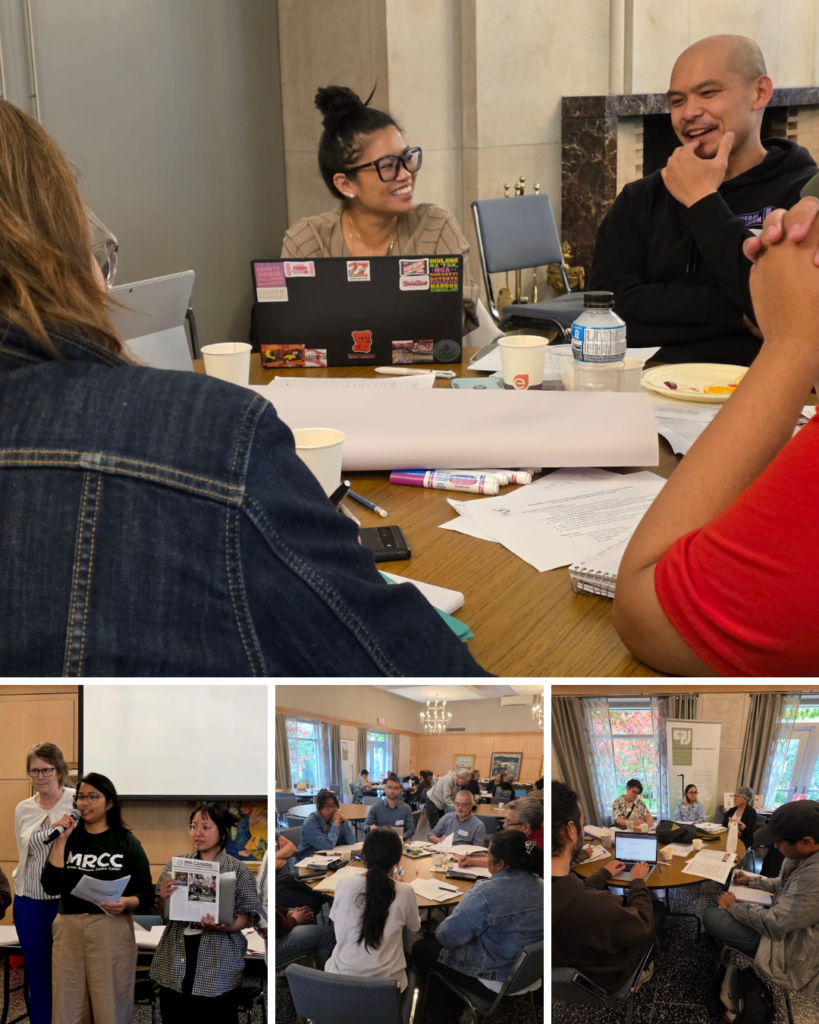
From the regional breakout discussions, migrant organizations, service providers, and faith communities shared and exchanged ideas on priorities, strategies, areas of collaboration and engagement, networking, educating and organizing, and doing broad solidarity work.
The day concluded with a song performed by cultural collective Parallel Play Kolektib – the song “What Did I Do Wrong?” written by Marikit Saturay, a refugee, migrant activist, and cultural worker.
Day Two moved into discussions about the organizational structure and future direction of CWWM-Canada, from a historically church-based network toward a broader, more inclusive interfaith movement. The forum participants affirmed that the network should welcome diverse
spiritual traditions and strengthen cooperation among grassroots migrant organizations, faith communities, and service providers. It also confirmed new and interested CWWM – Canada members.
Campaign discussions included proposals to use more inclusive language reflecting diverse spiritual traditions; strengthen relationships with communities in the Global South; develop more proactive international solidarity strategies; and build local regional networks that respond to realities across Asia, Latin America, and other regions.
Moving forward into the next couple of years, CWWM-Canada looks forward to a shared multilingual repository of education and campaign resources and materials in multiple languages, the mapping of allies and organizations, and a structure of regional conveners in
cities across Canada.
The Interfaith Forum united on a shared commitment to build an inclusive, grassroots, and action-oriented movement rooted in faith, dignity, and solidarity with migrants and migrant workers.
Churches Witnessing With Migrants (CWWM)-Canada is a tripartite body of equals that includes migrants, migrant-serving groups and organizations, and faith-based organizations from various traditions. For more information, please contact at: [email protected]