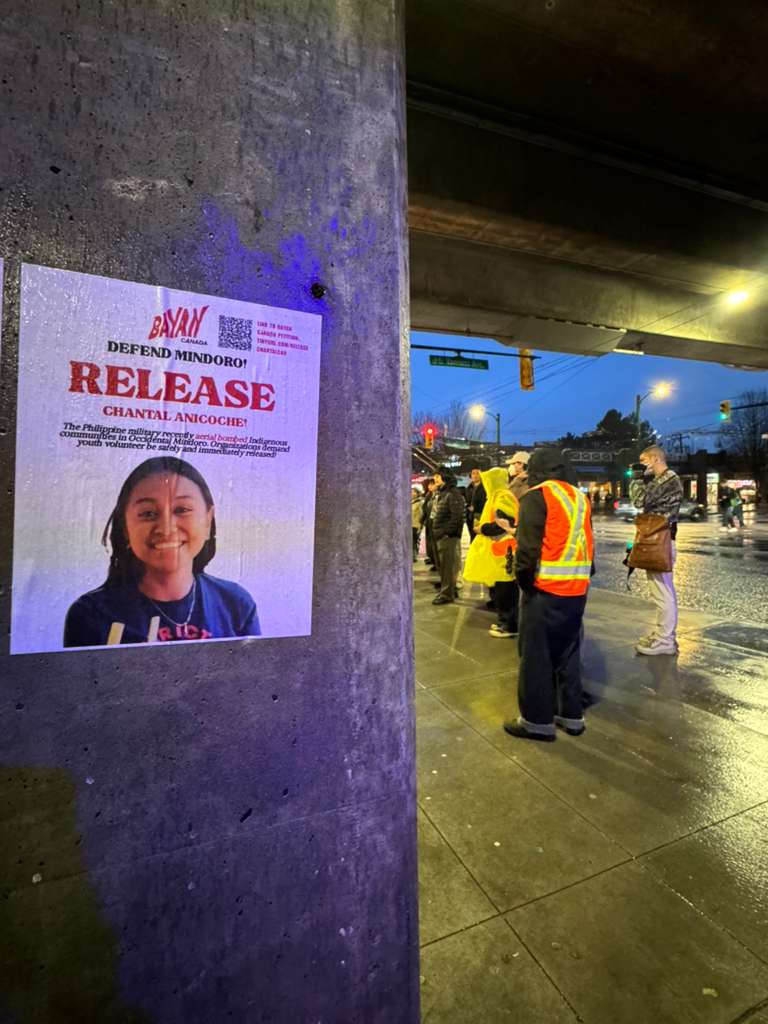


Ni L. Queano | Enero 6, 2026
Update: Written after the bombing on January 1st and several days before Chantal Anicoche was surfaced (“rescued”) by the military. Chantal continues to be detained by the military. Local and international support for Anicoche and for the communities bombed by the military helped in the pressure to surface Anicoche. English version follows the original poem in Tagalog.
Kung Saan Tumangging Manahimik ang Lupa
Hindi dumating si Chantal sa kanayunan upang maging bayani.
Dumating siya upang makinig.
Dumating siya na ang mga kamay ay sanay pa sa silid-aralan at mga pahina ng kuwaderno,
dala ang mga tanong na hinasa ng pagmamahal sa isang bayang kilala niya
sa mga salaysay ng pag-alis ng kanyang mga magulang.
Hindi siya sinalubong ng ginhawa ng Mindoro—
kundi ng katotohanan.
Ang lupa ang unang nagsalita—
sa bitak-bitak na lupa,
sa mga ilog na may alaala ng mga bagyo,
sa tahimik na tibay ng mga kababaihang Mangyan
na pasan ang buong mundo sa kanilang mga balikat.
Dito natutong maglakad nang marahan si Chantal,
isabay ang paghinga sa ritmo ng pagtatanim at paghihintay,
unawain na ang mismong pag-iral ay isang anyo ng paglaban.
Sa gabi, umiikot ang mga kuwento sa paligid ng apoy
na parang mga bantay na espiritu.
Mga kuwento ng sundalo, ng mga helikopter
na naghihiwa sa langit,
ng mga tahanang iniwan hindi dahil ginusto,
kundi dahil pinilit.
Tahimik na nakinig si Chantal,
mahigpit ang panga, nag-aapoy ang dibdib.
Doon niya naunawaan:
ang kapayapaan ay hindi kawalan ng ingay—
ito ay presensya ng katarungan.
Nang umalingawngaw ang langit,
wala itong awa.
Nayanig ang mga burol na minsang nag-aruga ng ani.
Kumapit ang mga bata sa kanilang mga ina.
Nagkawatak-watak ang mga pamilya
na parang mga binhing tinangay ng bagyo.
Kasama nila si Chantal sa pagtakbo,
nilulunod ng putik ang kanyang mga paa,
dinadaganan ng takot ang kanyang dibdib—
ngunit hindi siya lumingon.
Ang pag-alis ay pagtalikod sa katotohanang
kanyang piniling dalhin.
At pagkatapos—
katahimikan.
Hindi katahimikan ng kapayapaan,
kundi katahimikang ipinataw ng kapangyarihan.
Katahimikang pilit binubura ang mga pangalan,
itinatago ang mga saksi,
at nagpapanggap na ang kanayunan
ay sapat na bakante upang bombahin.
Ngunit naaalala ng lupa si Chantal.
Naaalala nito ang kanyang mga tanong.
Ang kanyang pagtangging pumikit.
Ang kanyang paniniwala na ang pakikiisa ay hindi kawanggawa,
na ang katarungan ay hindi ibinibigay
kundi ipinaglalaban.
Maaaring itago ang kanyang katawan,
ngunit hindi ang kanyang mga yapak.
Bakas ang mga ito sa mga burol,
sa mga silid-aralang minsan niyang tinayuan,
sa bawat tinig na ngayo’y
sumisigaw ng pagtutol.
Nawawala si Chantal—
ngunit hindi siya naglaho.
Nabubuhay siya sa bawat panawagang
sumisigaw sa lansangan,
sa bawat kamaong nakataas laban sa katahimikan,
sa bawat pamayanang nagsasabing:
Narito pa rin kami.
Hindi lumuluhod ang kanayunan.
Hangga’t hindi lumilitaw si Chantal katulad ng maraming iba pa,
hangga’t hindi humihinto ang mga pambobomba,
hangga’t hindi malaya ang lupa—
magpapatuloy ang pakikibaka.
Read the FULL STATEMENT and Updates from BAYAN USA , BAYAN USA DMV Dc-Md-Va and Migrante USA :
🔗 FB https://www.facebook.com/share/1Cudks6QvZ/
English translation:
Where the Land Refuses to Remain Silent
By Lui Queano, Jan 6, 2026
Update: Written after the bombing on January 1st and several days before Chantal Anicoche was surfaced (“rescued”) by the military. Chantal continues to be detained by the military. Local and international support for Anicoche and for the communities bombed by the military helped in the pressure to surface Anicoche.
Chantal did not go to the countryside to be a hero.
She came to listen.
She arrived with hands still used to the classroom and the pages of notebooks,
carrying questions honed by love for a country she knew
from the stories of her parents’ migration.
She was not welcomed by the comforts of Mindoro—
but by the truth.
The land was the first to speak—
in the parched earth,
in the rivers that held memories of storms,
in the quiet strength of the Mangyan women
who bear the weight of the world on their shoulders.
It was here where Chantal learned to walk slowly,
synchronize her breathing with the rhythm of planting and waiting,
understand that her conviction itself is a form of resistance.
At night, stories swirl around the fire
like watchful spirits.
Stories of soldiers, of helicopters
That cut through the sky,
of homes abandoned not by choice,
but by force.
Chantal listened quietly,
jaw clenched, heart on fire.
She understood it then:
peace is not the absence of noise—
it is the presence of justice.
When the heavens roared,
there was no mercy.
The hills that once nurtured the harvest trembled.
Children clung fiercely to their mothers.
Families scattered
like seeds swept away by a storm.
Chantal ran with them,
her feet drowned in mud,
her chest weighed down with fear —
but she did not turn to look back.
To leave was to turn away from the truth
she chose to carry.
And after that—
silence.
Not the silence of peace,
but the silence imposed by power.
Silence that forcibly erases names,
hides witnesses,
and pretends that the countryside
was empty to justify bombing.
But the land remembers Chantal.
It remembers her questions,
Her refusal to close her eyes.
Her belief that solidarity is not charity,
that justice is not given
but fought for.
Her body may be hidden,
but not her footprints.
They are etched in the hills,
in the classrooms she once stood in,
in every voice that now
shouts in defiance.
Chantal is missing —
but she has not vanished.
She lives in every call
shouted out in the streets,
in every fist raised against silence,
in every community that says:
We are still here.
The countryside does not kneel.
As long as Chantal remains missing (captive) like many others,
as long as the bombings do not stop,
as long as the land is not free—
the struggle will continue.
###